
Sex Offender Checks in Clay County
The Texas Public Sex Offender Registry is the first official channel for a Clay County sex offender check. DPS offers three distinct routes: an address search backed by mapped coordinates, a name search, and an institute-of-higher-education search. The public interface is free and shows no account requirement. Start with the route that fits the question. Use a full first and last name for a person, an address for nearby records, or an institution and campus for a college-based search.
Clay County does not publish a separate county offender list, municipal registrar directory, or local registry map. The Clay County Sheriff's Office links residents to the DPS system. Call the Sheriff when the correct local registration authority is unclear. NSOPW adds a national search layer, but it does not replace the Texas source. Each channel serves a narrow role, and a missing result should not be read as a court finding.
Prepare the facts before searching. A full legal name and birth date help narrow a name query. A street location is more useful for the address path. College searches need the institution and then the campus. When a profile appears, compare several identifiers rather than choosing the first similar name. DPS publishes registration information, not a finding that a listed person now lives at every place a user may associate with that name.
The Sheriff's main line is also the verified fallback for a Clay County resident who needs to identify the proper local registrar. Chapter 62 sends a person living inside a municipality to its police chief and a person outside a municipality to the county local law-enforcement authority. Because the qualifying city sites do not publish registrar contacts, callers should describe the residence area and ask which office has responsibility. No unverified local registration hours or fee should be assumed.
Keep the registry, local registrar, and court roles distinct. DPS maintains the public statewide search. A local registration authority receives and verifies information required by Chapter 62. The court file supplies the case history behind a conviction. One office may be able to direct a caller to another, but it does not merge those records. This separation is especially important in Clay County, where no municipal registrar page is published and the Sheriff's official page is the verified starting point for local routing.
Clay County Registry Search Paths
The three DPS paths do not use the same inputs. Address search accepts mapped or manually entered location values. Name search requires both first and last name, while birth date is optional. The education route first asks for a statewide institution and then loads the matching campus list. DPS also describes name, area, and institution searching, so users should switch paths when one set of facts is incomplete.
An address result depends on mapped data and the residence information available to DPS. It should be read as a registry response, not as a promise that every nearby place has been checked in some other local file. The institution route is also distinct from a general address query. Selecting an institution loads a campus choice, which matters when one school system has more than one site. Clay County users should keep the route they selected in mind when interpreting what did, or did not, appear.
The official DPS registry screen shows the Texas search interface used for Clay County results.
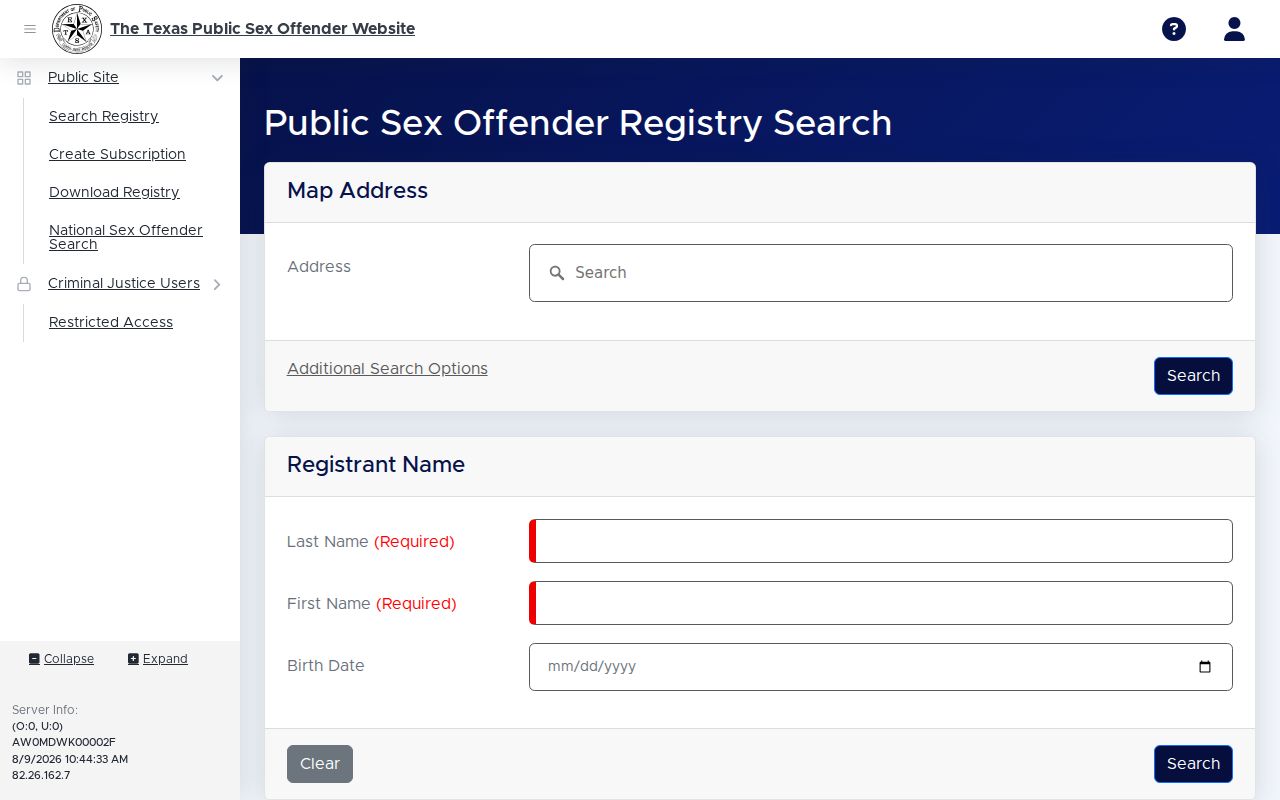
This view helps distinguish the three official search choices before any individual profile is opened. It also avoids reliance on commercial lists that may be stale.
How to Search the Texas Public Sex Offender Registry
Texas DPS manages the statewide registry and publishes the search controls it has authorized for public use. A careful Clay County registry search starts with the best known identifier and treats each result as a possible match until the profile details align.
No account or public-search charge is displayed. Use the Reset control between materially different searches so old values do not carry forward. A name search should use complete names rather than a guess at an initial. Birth date is a narrowing field, not a required key. Once a result is opened, note its reported address, registration status, offense entry, and verification information. Those fields help show whether the record answers the safety question that prompted the search.
- Open the DPS registry and choose Address, Name, or Institute of Higher Education.
- Enter the required fields. For a name search, supply both first and last name; add birth date only when known.
- Review the result list and compare reported facts. Do not rely on the name alone.
- Open the profile and read the offense, status, address, and verification information in context.
| Field Label | Type | Required | Notes |
|---|---|---|---|
| Address | Map-backed text | For address search | Uses mapped coordinates or manual input. |
| Last Name | Text | Yes, for name search | Must be paired with a first name. |
| First Name | Text | Yes, for name search | Must be paired with a last name. |
| Birth Date | Date | No | Can narrow a name result. |
| Institute | Dropdown | For institution search | Select from the statewide list. |
| Campus | Dropdown | Conditional | Loads after an institution is selected. |
Clay County Registry and NSOPW
The DPS registry is the direct source for Texas records. The National Sex Offender Public Website, maintained by the U.S. Department of Justice, searches participating jurisdictions across state lines. NSOPW is useful when a person may have moved or when a safety search covers more than Clay County. Its result still points back to the contributing jurisdiction, where the current profile should be checked.
The official NSOPW search provides that cross-state layer.
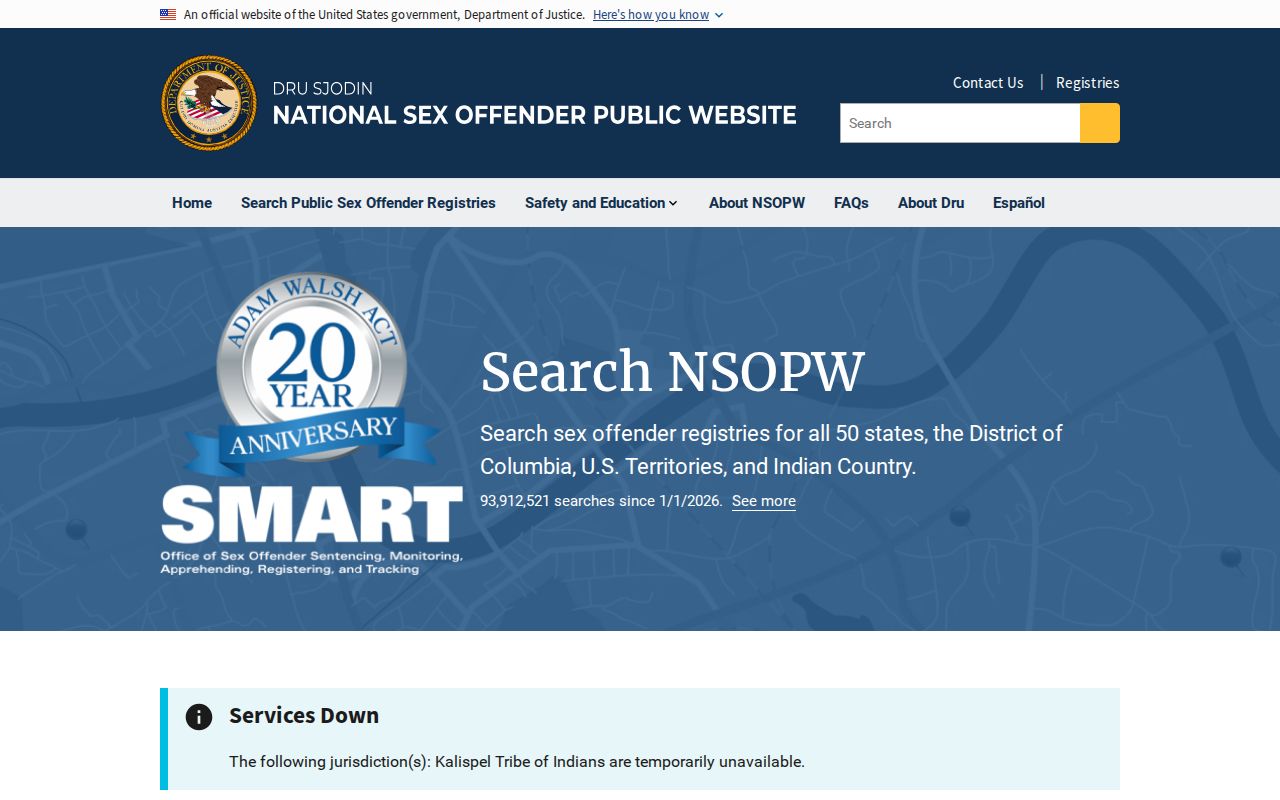
This national screen is a supplement, not a second Clay County database. When Texas and national displays differ, confirm the record through DPS and the agency that supplied the entry.
Jurisdictions contribute their public information to the national service under their own laws and practices. That can affect which fields appear and when an update reaches the cross-state display. For a Texas registrant, the DPS record is the closer source. For a person whose history or reported residence crosses a state line, NSOPW can reveal another participating jurisdiction that should then be checked at its source. Neither tool is a substitute for an urgent call to law enforcement when there is an immediate safety concern.
Note: A national no-result does not change a Texas registration duty or establish that no Texas record exists.
Inside a Registry Profile
A Texas public profile may contain a recent color photograph, aliases, physical descriptors, permitted birth-date information, a reported address or geographic residence description, offense and conviction facts, risk level, punishment, supervision status, and verification details. Some records may also show higher-education data, identifying marks, or specified vehicle details. Individual fields vary because the statute, the source record, and the person's reporting duties shape what DPS may display.
Physical details can include sex, race, height, weight, eye and hair color, and shoe size. For specified trafficking convictions, public vehicle information may include make, model, color, plate, or VIN. Higher-education information may identify a status and institution. These fields are not guaranteed on each profile. A photograph or descriptor can help distinguish similar names, but profile data should still be assessed as a whole. The public view is a safety record assembled under Chapter 62, not a complete personal dossier.
| Name & Aliases | Reported full name and alternate names where public. |
|---|---|
| Photo & Description | Recent color photo plus sex, race, height, weight, hair, eyes, and other descriptors when present. |
| Reported Residence | Home address or a geographic description allowed for public display. |
| Offense Record | Registered offense, conviction date, victim age category, punishment, and supervision facts where authorized. |
| Risk Level | Level 1, 2, 3, or Civil Commitment designation. |
| Registration Details | Status, verification information, and school or vehicle details when applicable. |
Clay County Registry Profile Limits
A registry profile is not a full criminal case file. Texas keeps Social Security numbers, driver-license numbers, phone numbers, online identifiers, employer identifiers and contact data, victim identity, and protected juvenile information out of public view. Other additional data that DPS requires can also remain confidential. The absence of a field may reflect a legal restriction or the fact that it does not apply.
Victim identity is not public merely because a profile may show an authorized victim age or sex category. Confidential identifiers should never be sought through unrelated public sources to fill a registry blank. A profile can list punishment and supervision information without reproducing every order in the case. It can show a risk designation without explaining every assessment input. Those limits protect sensitive data and keep the public registry focused on the information Texas law authorizes DPS to release.
Use the offense and conviction entries to locate the relevant court record if more context is needed. A Clay County registry entry cannot show every filing, plea, order, or later docket event. For that level of detail, the Clay County criminal court case file is the better source. Never infer a missing fact from a blank profile field.
Texas Registration Levels and Requirements
Texas risk levels describe assessed danger, while registration duration follows the offense and statute. The two concepts should not be merged. Adult registration can last for life or for ten years after the latest qualifying discharge, release, or supervision event. Juvenile rules use their own ten-year measuring points. Verification frequency is also separate: most registrants generally verify annually, people with two or more sexually violent offenses generally report every 90 days, and certain civilly committed people outside a center report every 30 days.
Level 1 means DPS characterizes the person as a low danger who is not likely to engage again. Level 2 indicates moderate danger and possible continued conduct. Level 3 describes serious danger and expected continuation. Civil Commitment is a court designation for a sexually violent predator under intensive supervision and treatment. None of those labels, by itself, answers whether registration lasts ten years or for life. The controlling offense and statutory timing event supply that answer.
For an adult ten-year term, the clock follows the latest applicable event among court discharge or dismissal, release from confinement, and discharge from community supervision. Juvenile adjudication generally uses ten years after the later of disposition or completion. A transferred juvenile conviction or deferred matter generally uses ten years after the later of release, supervision discharge, or court discharge. Because the rule is offense-specific, users should not calculate an end date from risk level or from an old profile screenshot.
The profile's offense and conviction details provide context for a registration duty, but DPS directs users to the controlling offense list for the legal term. A release date alone may not start the clock if community supervision ended later. A court discharge may also matter. This is why a Clay County registry search should report what the current official profile says without making a private estimate of when the record ought to disappear. Questions about a duty or end date require the official record and qualified legal advice.
| Texas Designation | DPS Meaning | Duration / Verification |
|---|---|---|
| Level 1, low | Low danger; not likely to engage again. | Duration is offense-based; verification is generally annual unless another rule applies. |
| Level 2, moderate | Moderate danger; may continue. | Duration is offense-based; frequency can change based on qualifying offense history. |
| Level 3, high | Serious danger; will continue. | Duration is offense-based; public notice rules may apply. |
| Civil Commitment | Court-designated sexually violent predator under intensive treatment and supervision. | Certain residents outside a center verify every 30 days. |
Clay County Registration and Notice
Texas requires advance and follow-up reporting for many address moves. A move generally calls for in-person notice seven days before departure and notice to the new Texas authority within seven days after arrival. Inside a municipality, Chapter 62 routes registration to the police chief. Outside a municipality, it routes the duty to the county's local law-enforcement authority. Because Henrietta, Petrolia, and Byers do not publish municipal registrar contacts, residents should call the Clay County Sheriff to confirm the right office instead of assuming the Gilbert Street desk handles every case.
For a high-risk or civilly committed move, DPS sends English and Spanish postcards within one mile in an unsubdivided area or three blocks in a subdivided area. Local authorities may also publish high-risk notice, and specified schools receive notice in child- or student-related circumstances. These are legal notification channels. They are not a reason to circulate an individual's profile beyond a real safety need.
Verification is an ongoing reporting duty, not a promise that all profiles are identical from day to day. Most people generally report around their date of birth each year. The shorter 90-day and 30-day cycles apply to the categories Texas identifies. If a Clay County profile seems inconsistent with a known move, the safe response is to contact the appropriate authority and provide the official profile reference. Public users should not attempt their own compliance investigation.
Clay County DPS Registry App
The Texas DPS state app is separate from Clay County's web resources. Research found no official Clay County Sheriff app or qualifying city police app. DPS advertises state sex offender searches by location, name, route, and proximity, which may help with a mobile safety check. Treat those tools as another view of state data, not as a county-maintained registry.
A route or proximity search can serve a different purpose than the browser's person-focused name query. Someone planning a trip may want location context, while a reader checking a known person needs a name and supporting identifiers. The app's Texas 10 Most Wanted feature is separate from the registry and must not be confused with registration status. Likewise, the lack of a Clay County agency app does not mean registry information is unavailable. DPS supplies both the statewide web interface and the state mobile route.
Web search remains the clearest place to review profile fields and the conditions of use. The app can support a location-based check, but a question about registration authority or a conflicting Clay County detail still belongs with DPS or the proper local registrar. Keep the source distinction clear.
Community Notification and Lawful Use
The registry exists to aid informed safety choices and community awareness. It is not a substitute for a police report, a court judgment, or direct advice in an urgent situation. Read the date and status on the official profile, avoid spotlighting a private person beyond what Texas law publishes, and verify a material concern with DPS or the correct local authority. Chapter 62 governs registration duties and public information, but the public access it creates does not authorize retaliation.
Use the smallest amount of information needed for a sound safety plan. An official notice or current profile can inform household routines and community awareness without being reposted with inflammatory claims. Risk level, duration, and verification frequency are separate facts. An offense label is not a full narrative. When further context is necessary, use the originating court and agency rather than guessing about facts the registry law keeps nonpublic.
Registry misuse is unlawful: Texas Code of Criminal Procedure Chapter 62 does not permit anyone to use registry information to threaten, harass, injure, or commit a crime against a listed person.
When facts appear wrong, preserve the profile link and contact the agency responsible for the record. Do not confront the person named. For an immediate threat, use the proper emergency channel. For a nonurgent registration question, the Clay County Sheriff's Office can help identify the local authority, while DPS remains the manager of the statewide public database.